Sunday, October 19, 2014
TOW #7 - 3 Most Important Things in Life - Harlan Ellison (Written)
Harlan Ellison was, at the time of the anecdote he references in this essay, a "Nice quiet Jewish kid from Ohio... a published author... well into terminal destitution. Poverty would have been, for me, a sharp jump into a higher-income bracket." He introduces himself as such to give the impression that he's been in many walks of life, and that he's experienced many things. This is a good way of establishing ethos bit by bit throughout the entirety of the essay. Most of the essay, however, is focused around getting to readers' emotions through the use of humor and vivid descriptions of the environment, both physically and emotionally. This focus on pathos seems appropriate for the topic of the essay, being the importance of Sex in one's life, with sex being a thing of emotion, not logic. The essay was originally published in a porn magazine, which matches the lack of true philosophical depth in the essay - though the title claims to speak on the subject of the importance of sex in one's life, the true purpose is to simply tell a story. Ellison does so with stark clarity, using descriptive but simple diction to get the events that he's relating across with style and grace. He also makes great use of humor throughout the essay in order to keep his readers interested. He uses surprising events and descriptions to evoke humor, such as the end of the essay, whereupon tying his date to the ground, naked, in the kinkiest of positions, instead of furthering his conquest, he leaves. Another funny bit of surprise is when his date suddenly asks him to hit her. These humorous moments, coupled with vivid descriptions that truly put you in Ellsion's shoes, come together to help Ellison achieve his true goal of narrating an entertaining anecdote quite well.

Sunday, October 12, 2014
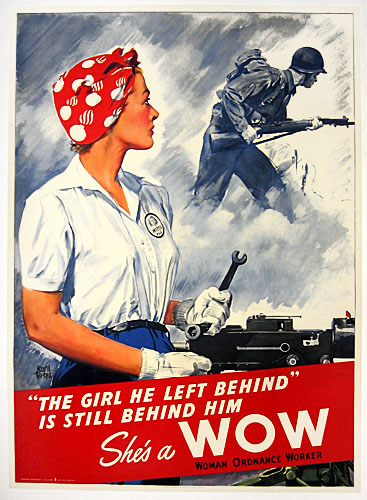
TOW #6 - She's a W.O.W. - Visual
The following image, called She's a W.O.W., was illustrated by a man named Adolph Triedler. He was a fairly well-known artist from the beginning of the 20th century through 1981, when he died. He illustrated in several different "genres" - he did a large number of magazine covers and commissioned advertisements in his time. She's a W.O.W. is one of these commissioned pieces. The poster was created in 1942 to attempt to get more women to help in the war effort for WWII by becoming Woman Ordnance Workers, or WOWs, or in simpler terms, weapon makers. The image evokes emotions of guilt and then confidence in order to persuade women to join the war effort. The image was produced in 1942, in the midst of WWII, one of the most brutal wars that the world had seen to date. Many men had gone off to war and left their families behind, and people were feeling as if they weren't doing enough to help their country. The poster plays on this by referencing "The girl he left behind", targeting in specific the wives and girlfriends of the men who went off to war. Calling them "The girl he left behind" is a way to make it seem like the women are staying at home and not doing their part. However, after this guilt, the image offers up a solution - a way to give the "women who were left behind" a chance to help out and be useful. The use of the phrase "Still behind him" acknowledges the fact that the women working will not be at the forefront, but still helping. They show an empowered-looking woman, standing tall, shoulders square, looking upwards and onwards, saying "you can be this empowered, if you become a WOW". Overall, it's failry effective given the gender roles that were present and accepted at the time, it showed something that women could do to feel powerful, and used that want to be useful to get workers for the war effort.
Sunday, October 5, 2014
TOW #5 - Damn it Feels Good to be a Gangster (written)
Damn it Feels Good to be a Gangster is a song by the 90's rap group The Geto Boyz. Like many others of the time, The Geto Boyz worked in a genre called gangster rap. Songs within the genre often tackled two general topics: the definition of and the degree of being a gangster that the authors of the song have achieved, and modern politics. Both of these topics are heavily delved into throughout the text. The first topic is adressed at the very start of the song, with the lyrics "Damn it feels good to be a gangster." Spoken by Scarface. Right out of the gate, defining himself as a gangster, saying it as if everyone knew it to exude an air of confidence in his being gangster. Shortly thereafter, he defines being a gangster as being a relaxed, non-confronttional, unbragging, philosophical person. All of these points are made with direct statements, delivered in a didactic tone so as to convince people that these things are the definition of a gangster without any real, direct proof. In a later verse, Scarface goes on to say that gangsters are decisive and "pull the trigger" without talking about it much, and that real gangsters don't run away from their problems. He uses the sme rhetorical devices from the first verse to this one. The last verse, spit by J. Prince, is one that adresses the topic of modern politics. At the time of release, George W. Bush was the president of the United States of America. J. Prince takes a negative stance towards Bush's presidency, and makes many accusations that are mainly supported by ethos. He calls Bush a gangster, something that one wouldn't want their president to be. He then accuses Bush of "Lettin' a big drug shipment through (and sending it) to the poor community so we can bust you know who." This accusation of purposefully letting drugs into the poor community on purpose in order to keep them down and catch drug dealers is a very strong statement, and is guaranteed to raise strong emotions of support in the audience, which was mostly intended to be consumers of gangster rap, who tended to be anti-Bush. This appeal to ethos in people who are already in support of J. Prince's ideas is guaranteed to get Prince's desired effect. Overall, Damn it Feels Good to be a Gangster is a successful rhetorical text in its goals to define a gangster and criticize George W. Bush, but mostly in its intended audience of gangster rap consumers. To anyone outside of that consumer base, the first point may be even more successful in that the audience is solely basing their opinion on what a gangster is on what Scarface is saying. The second point may be far less convincing, however, because of the baselessness of the claims made towards Bush's behavior.
Saturday, September 27, 2014
TOW #4 - How To Win Friends and Influence People (IRB)
How to Win Friends and Influence People is a book by Dale Carnegie, a writer and lecturer who focused a lot on self-help and social improvement. Many of his works focus around the idea that one can influence and change the behavior of others by changing your behavior towards them. That idea is very present in How to Win Friends and Influence People. One might even say that its one of the central pillars of the book so far. Well, I'm saying it. The book is a self-help book, but I feel like that title does both the book itself and its audience injustice. The book is accessible to literally anyone who wants to improve their social skills, be it for solely interpersonal reasons, or if they want to succeed more in the business world by networking better. The book has been a standard for improving social skills since the 30's, when it was released. Its advice has stayed relevant even until today. The book utilizes many, many many anecdotes from successful people supporting exactly why the strategies Carnegie suggests would work, which is a strong appeal to ethos. I feel like the book so far is sort of lacking in logos, but that makes sense. Social "science" is more abstract than any other science, and this book was written in the 30's, so some of the information about how the brain acts in social situations wasn't available, so an imbalance in Ethos and Logos is okay. Overall, I find that Carnegie has been achieving his purpose very effectively. His purpose is to help people to function better in social situations and to interact with people more effectively without any sort of malicious manipulation. He achieves this well, because I've been using some of the strategies he outlines in the book, and I feel like I've been overall better in social situations. It's a book that's gained popularity from the testimony of those who were affected by it, and I'm tossing my lot in with them.
Sunday, September 21, 2014
TOW 3: Serial Experiments Lain: Weird (visual)
Serial Experiments Lain is a sci-fi TV show from the late 1990's. It is regarded for its artful direction. ambitious atmosphere, and a plot that is up for any sort of interpretation. It was produced by the now defunct Triangle Staff and directed by Ryutaro Nakamura, who has worked on over 29 different major projects over his career. This is the first episode of the series, so its purpose is to mainly set the scene and mood for the rest of the show. Considering that the first scene is the suicide of a middle-school aged girl, the audience is presumably a more mature group. Lain was produced in the era when Macintosh computers were just beginning to take over the world with their sleek, smooth designs, and their advanced capabilities. Lain focuses on that technological rush of the time, making the internet one of its main topics. As I mentioned earlier, the show begins with the suicide of a middle school girl. Shortly after this exposition, her classmates begin recieving emails from the girl who just committed suicide, saying that she left the corporeal world to become more present in The Wired, a construct that seems to be very similar to the then growing internet. It sets a dark, technological pretense over the episode, and gives the impression that the rest of the show is going to be this way. In scenes where Lain is traveling to and from school, be it by walking or on a train, there is always a faint electrical humming noise in the background, and power lines and cables are almost always overhead, adding to the technological theme of the show. The music in the show is very conservatively placed, and if there is music playing, it is very faint and ambient. Just like the music, dialogue and speech is kept to a very low threshold, usually being quiet and austere. All of the shadows in the show have a shifting red and black effect to them, as if to say that the shadows could be concealing anything. Many scenes involve several different angles of a room, following the same event in relatively quick succession, a direction choice by Nakamura that truly fleshes out the atmosphere of every scene. Very little plot advancement occurs in this episode, aside from Lain deciding to explore the idea of getting a computer and exploring the Wired that her dead classsmate spoke of. Instead, it uses its time to layer a dark, spacey environment in which every element is open for interpretation. Weird sets a great tone for the rest of Serial Experiments Lain.
Sunday, September 14, 2014
TOW 2 - Team Ben: A Year as a Professional Gamer
Team Ben: A Year as a Professional Gamer is about Chris Fabiszak, or as he is known in the competitive gaming world, "Wife", and his experiences as a professional gamer. He was, and still is to an extent, a professional gamer, and this is his memoir as both one of the driving forces behind and a participant in the "golden age" of Super Smash Bros. Melee. The book is mostly aimed at members or potential members of the competitive Super Smash Brothers scene, but can also be appreciated and understood by those who aren't really a part of the competition. Wife's purpose in writing the book is to tell his story while giving readers a little more understanding of just how technical Smash is. He achieves this by using a mainly narrative tone and having didactic interludes with frame data about the game - describing what exactly happens in the game is it happens, frame by frame - one sixtieth of a second at a time. This frame data provides much to his argument that Melee is an extraordinarily technical game, giving a strong backdrop of Logos to his argument. He tells the story as if it were an annotated paper - all of his thoughts about the situations he was in are on the page in front of you, giving you a truly first-person look at competitive smash through his eyes. Everything is thoroughly described, and we can feel his mind racing when he's in a match, and his mind wandering into realms unknown when he fantasizes about what smash could become. All in all, it's a great book that puts into words Smash's deep complexity and the wonderful experiences that one can have at the many tournaments that are hosted worldwide. I know this because I have lived a lot of what he talks about, and I feel that he puts the thoughts and feelings of a Smash player on paper better than I ever could.
IRB Intro 1 - How to Win Friends and Influence People
How to Win Friends and Influence People is a book by Dale Carnegie, and it was written in the early 30's. However, one still hears about it and its effectiveness, and any book that maintains its power after 80+ years must be very well written. I've heard great things about it, and its topic is something that I've been trying to work on recently - interacting with others and motivating yourself. It seems like its going to be full of different rhetorical strategies for me to analyze, so I think that it'll be a great fit for this class.
Subscribe to:
Posts (Atom)